
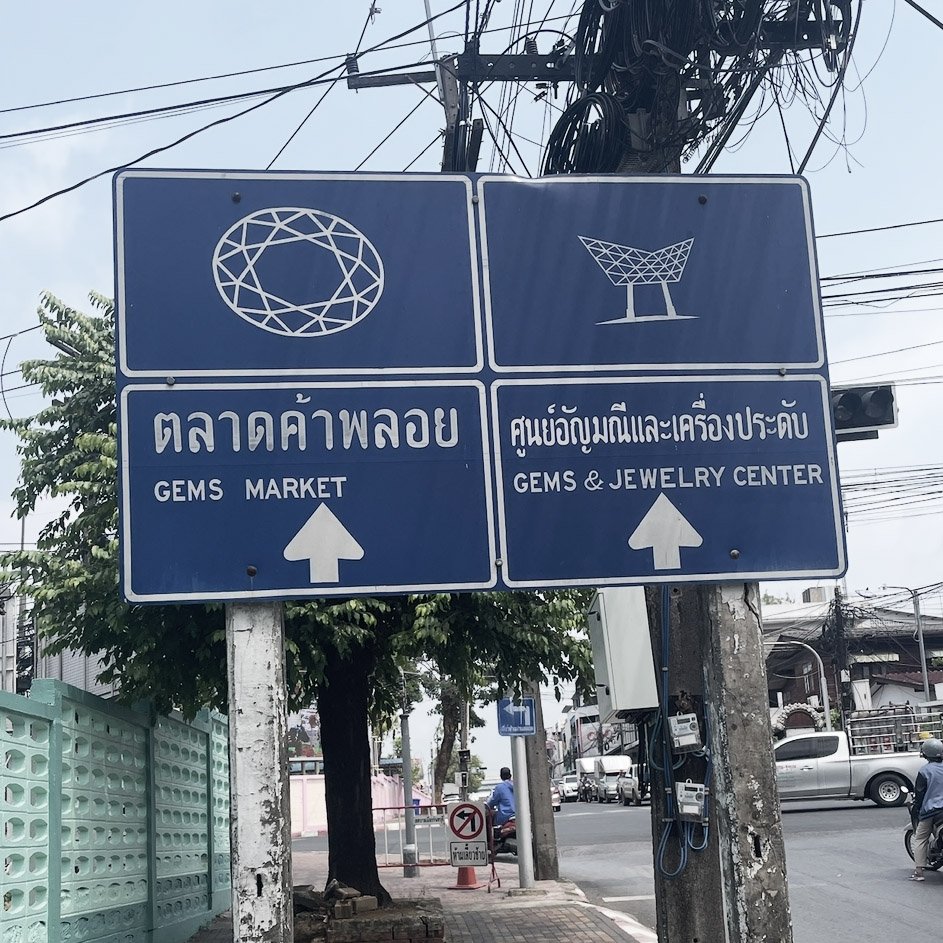
All roads lead but one way.
Januaray 2026
I originally wrote this nearly 2 years ago during my last South East Asia journey. Every time I reread it and thought about posting it, it felt like I sounded like a bumbling idiot and that the value of my ramblings were limited at best. This has not changed. However, in a few weeks I will be joining a gemstone trip thru Sri Lanka with a group of gemologists, visiting mines, markets, treatment rooms, etc. I am hoping to be able to answer at least some of the questions left hanging in my brain and share them with you. Stand by.
March 2024
Part of my quest to create a more sustainable brand is to experience more of the processes and supply chain from the ground up, or as close as I can get to the ground. Sometime around the end of 2021, possibly as a result of COVID isolations and being locked away from meaningful travel for two years, I decided to visit sapphire and ruby mines in Thailand. The problem is, or was, that there aren’t really any anymore. And that I have zero connections to casually show up next to a big pile of dirt and ask nicely if I can poke around a bit and maybe take a few pictures? Inquire if the workers feel satisfied with their payment, and is there any money going back into the local community? According to a decade old GIA post, there are still some active mines in production, but not many.
My plans were vague at best, but the research I did introduced me to the Gem Market in Chanthaburi. Chanthaburi was formerly the mining capital of Thailand and, as the mines became depleted, became the center for cutting and treating, and had a huge trading market. Thailand is warm and beautiful, and maybe I couldn’t go play in open pit mines, but perhaps something could be learned from going to a trading center. Perhaps some beautiful stones could be bought. Perhaps I would successfully escape from a Berlin winter. As my finger hovered so many times over the “Book Now” button on Kayak, Omicron reared its head. Thankfully, I had not yet managed to click thru, and the idea was tabled. My interest in clamouring about mines has only grown, however.
Fast forward to winter 2024, Berlin remained cold and dark and mama needed some sun. My expectations for Chanthaburi were decidedly unclear. I wasn’t sure if I would stepping into a sapphire and ruby utopia with friendly and fair local stone dealers completely open to taking me to their cutting rooms and showing me their treatment processes and of course I could take some pictures and ask any questions I wanted, or… something else. Really, I knew it would be something else, but wasn’t sure exactly what that else was.
I tried to do some research into how this market worked, and found this GIA Blog, and this. They are both incredibly helpful in explaining how things work here, and also were written by someone with infinitely more gemstone knowledge than myself. No bother, adventure time.
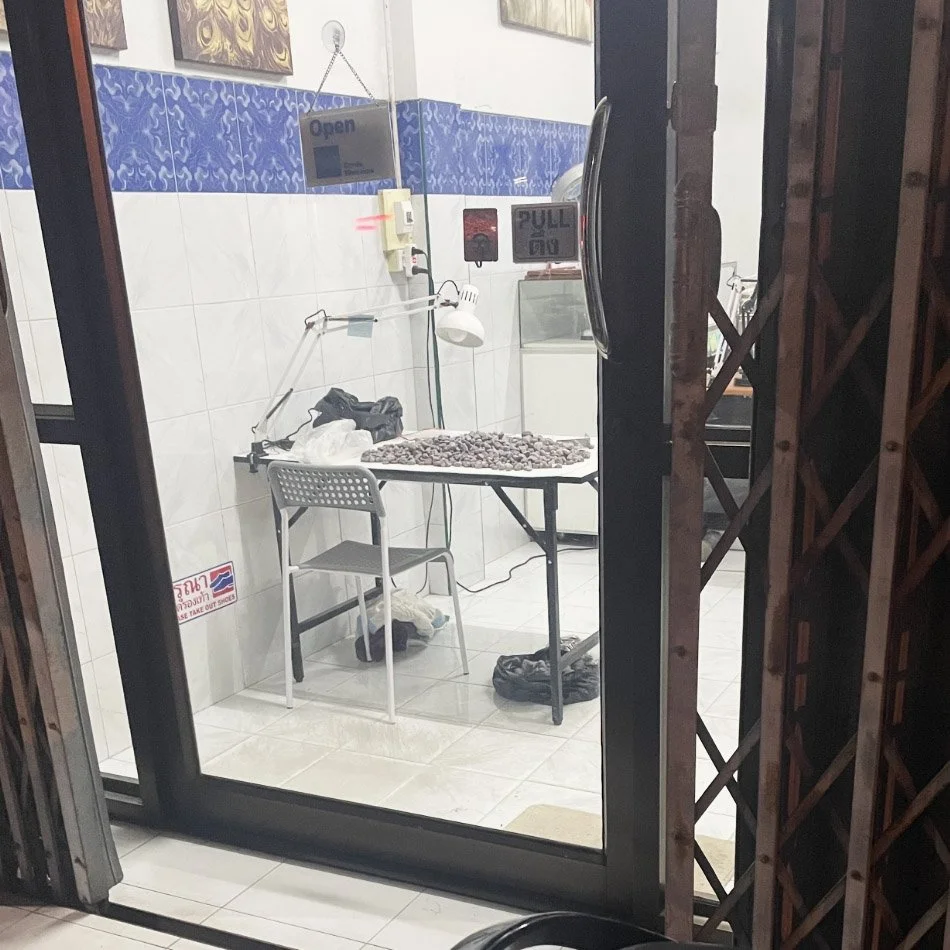
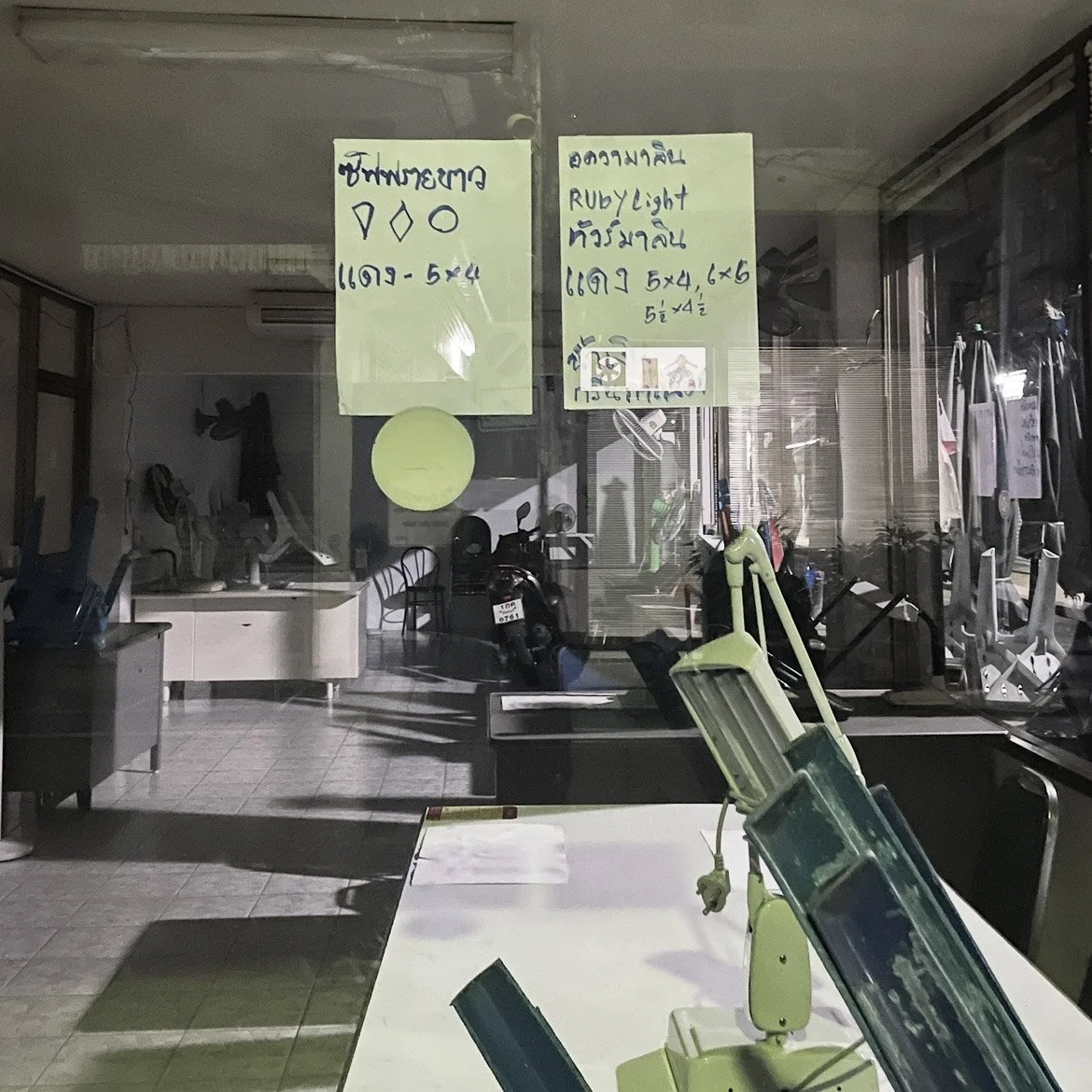
On my initial walk from the train station, I passed window after window of people at desks sorting with shakers massive piles of stones, or sorting by eye, or selling. Piles of rough sitting on desks in rooms completely empty of anything except another desk or two, some little baggies and a few scales. And some pictures of the King and a small shrine to Buddha. No stones in cases, no vitrines, nothing on display, just piles. Most of these store fronts had no formal signage, if anything, a scribbled note stuck to the window indicating what shapes they had available. Or possibly what they were looking for. It felt very much that taking pictures of people living their lives and doing their jobs would have been both invasive, and generally rude. My photography of this is therefore very limited, and these were taken after hours.
The actual open air gem market happens from Friday to Sunday and breaks the basic paradigms of capitalism. A number of storefronts open their gates so you have a free pass thru to the street. Each room has rows of heavy metal desks. Instead of dealers laying out wares, buyers take a desk and write on a sheet of paper what they are looking for and tape it to the front. Dealers or runners then come thru. Upside down capitalism.
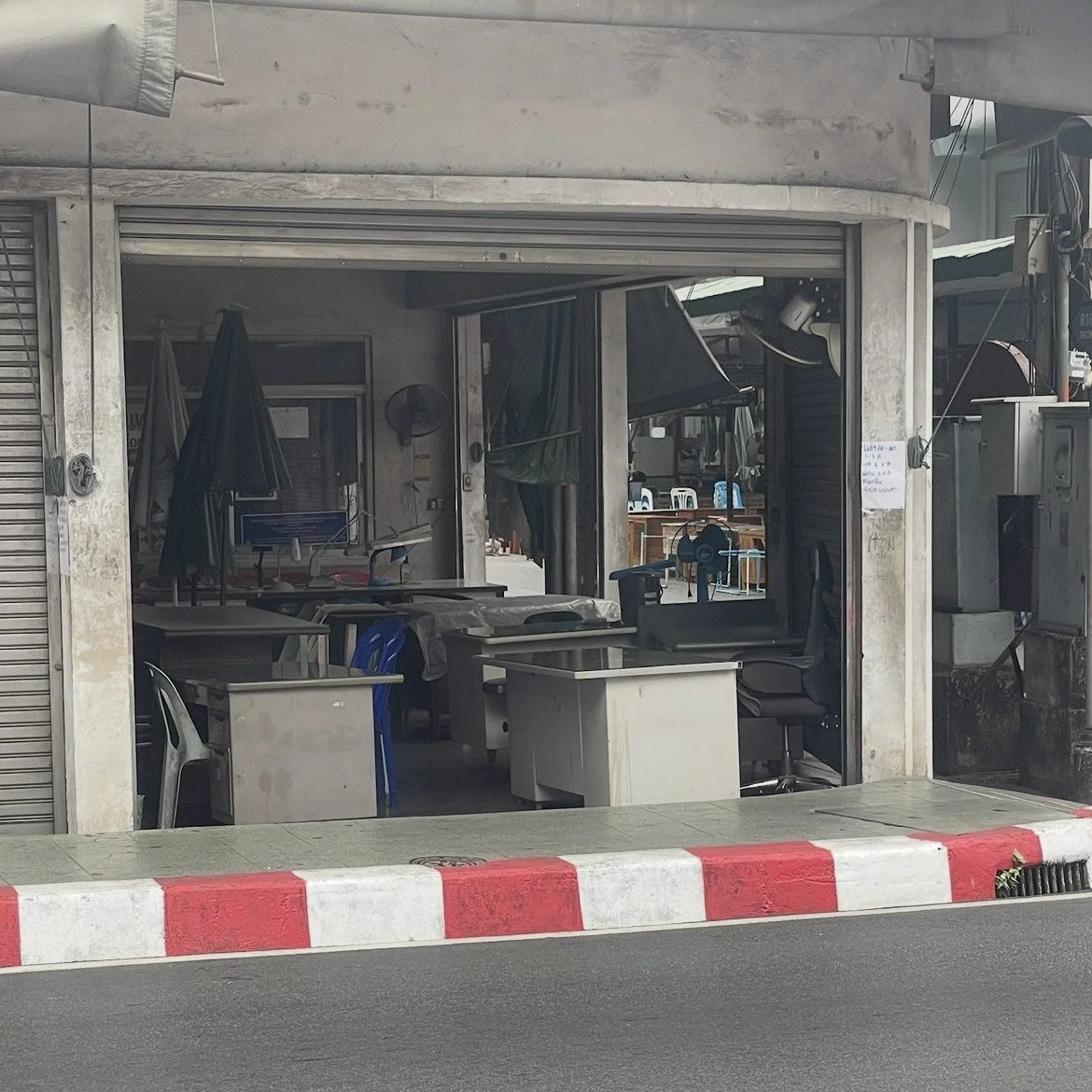
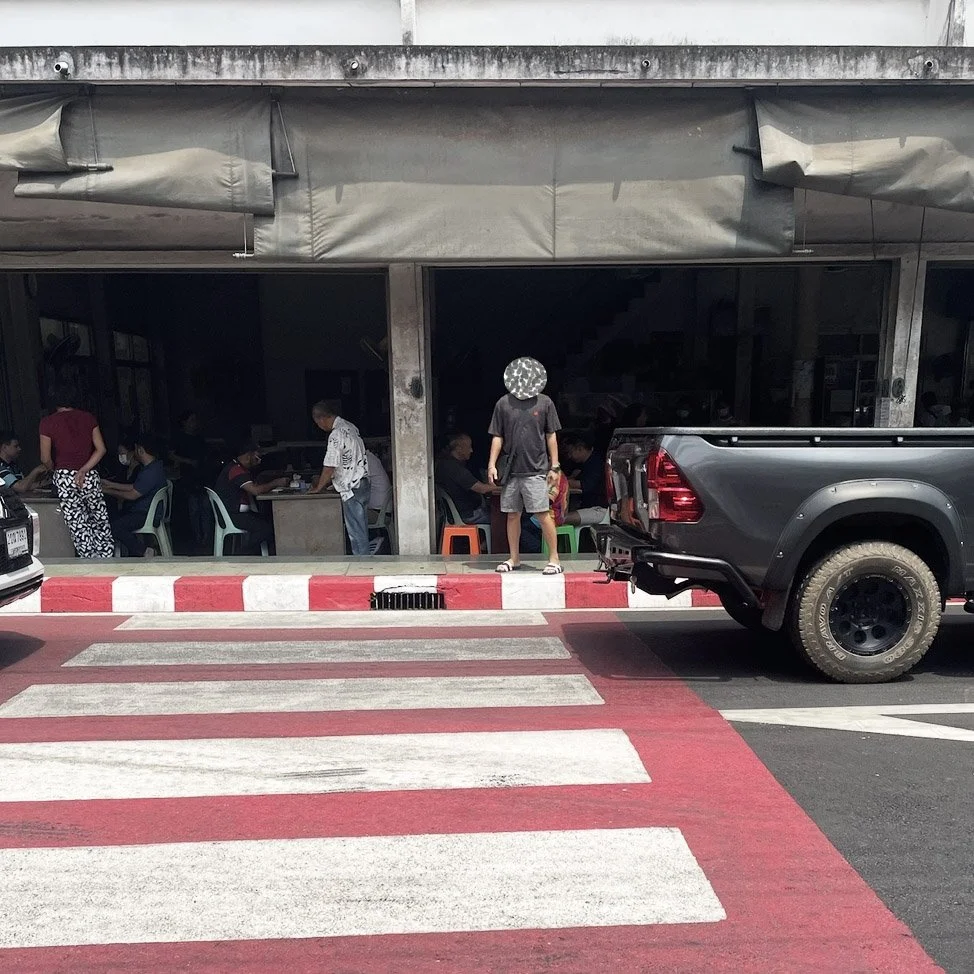
I passed thru multiple times in the course of a Saturday. It was immediately clear that I did not have a seat at the literal or metaphorical table. My hope or thought for stone buying was more in the traditional forms of capitalism, where products are on offer and you look at what is for sale, choose something or somethings that are shiny that you like and hope to exchange legal currency for said shiny objects. Having not so much of a budget left, and definitely not in the looking for hundreds of carats of something bracket, it felt imprudent to ask someone to make me a sign in Thai that said “Meh, surprise me, I have 3000 baht left.”
I also harboured something of an idea that the cutting and treating would be more on display, in some capacity. This proved also very much to not be the case. I felt like it was the equivalent of someone showing up to 47th Street in Manhattan and being confused about why there are no setters or casters working on the corner of 6th Avenue.
One to always give up only after at least a half assed attempt at something, I toodled back to my hotel and asked the very friendly receptionist, Mook, if there was anyway to organise a tour of the gem market, specifically back rooms. My thought process was along the lines of, maybe her brother or someone is a faceter and I can pay some money for someone’s time to go see… things. Unfortunately, this was also not possible, and she had never heard of such a tour. She did, however, suggest a mine tour, and pulled up a webpage of smiling Thai children in a large hole. What I interpreted from what she was showing me was a place where children went on school trips to understand their local history and heritage better. She did also tell me that everyones brands and recipes of treatments were proprietary and that in general it wasn’t like any company or dealer was going to roll out the red carpet for someone that wanted to see their secret sauce. In so many words.
I took another trip thru the actual market, more out of directional necessity than desire. Most of the desks were filled with humans of the mostly male persuasion. Some had long lists in front of them, some had some things crossed off their lists. There were a lot of piles of stones on the desks and a lot of animated conversation over the typing of numbers into calculators. The festivities spilled onto the street where further animation and dealings happened. Again, this felt like a not cool place to casually take snap shots to show the kids at home. Nothing nefarious by any means, but this was not for the uninitiated. There was no floof, there was no casual marketing, people were here to buy and trade and it just happened to be on an open street corner. I did not see any other Westerner types at the tables, only one man louping something from one of the few street vendors engaging in traditional capitalism with stones on display. I took a look at those stones, and I am pretty sure what I was looking at could be bought for 25% of the marked price in the US or EU. Obviously haggling would happen, but it was very apparent that anything on display was for the casual tourist and not someone coming to make their deals for the first quarter.
Chantheburi Gem Market in a nutshell: Learned nothing about sustainability, nor anything else. Did not see any cool backroom anything. Interesting to see the market, but really only for actual stone dealers. I wish there was a jeweller/ gemologist/ goldsmith geared tour of some sort to see what happens behind the curtains. Unless you are a dealer or gemologist, Chanthaburi is worth it for a pass through but would not go out of my way to come here. It was still cool to the see market as an outsider though.